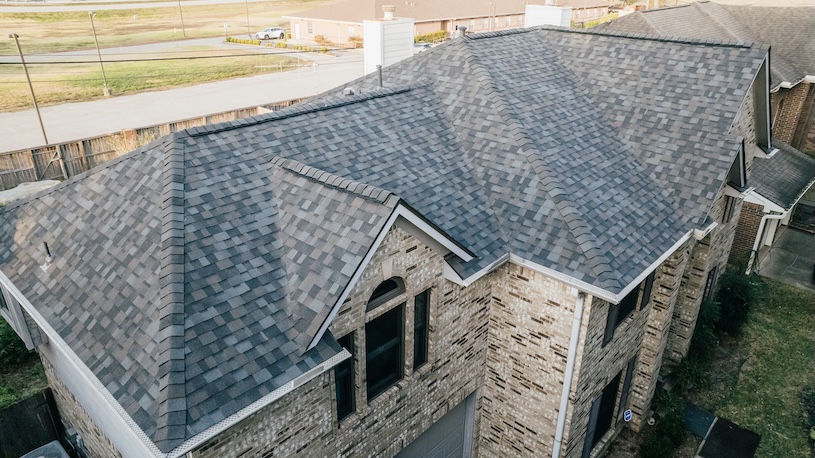
The honest answer to "how much does hail damage roof repair cost in Houston" is that you probably will not pay full price. Most documented hail claims pay out under your homeowner's insurance, and your only out-of-pocket is the wind and hail deductible (typically 1 to 2 percent of dwelling coverage). What the work actually costs the carrier matters because under-scoped claims leave you with a half-finished roof. This guide breaks down real 2026 Houston pricing for spot repair, partial-slope replacement, and full hail-claim replacement, with the line items adjusters and contractors negotiate over.
- Average hail repair cost out-of-pocket?
- Most Houston homeowners pay only their wind and hail deductible ($1,500 to $6,000 on a $200K to $300K home). The rest is covered by insurance.
- Without insurance?
- Spot repair $450 to $1,200. Partial slope $2,500 to $6,000. Full replacement $14,000 to $28,000 for a 2,500 sq ft Houston home.
- Class 4 upgrade cost?
- Add $800 to $1,800 over standard architectural on a full replacement. Many Texas carriers reimburse 10 to 30 percent of the wind/hail premium annually after install.
- Is the deductible negotiable?
- No. Texas Insurance Code §707.002 makes it illegal for a contractor to waive, absorb, or rebate it. Any roofer offering to is breaking the law.
Free inspection for your hail damage roof repair cost in houston project
Tell us what you are dealing with and we will schedule a no obligation inspection. Prefer to talk? Call (713) 480-8877.
01 // Insurance claim vs cash repair
Hail damage in Houston almost always goes through your homeowner's policy. The wind and hail peril is standard coverage on every Texas HO-3 policy. If the hail size was 1 inch or larger and the strike date is documented in the NOAA Storm Events Database, the carrier owes the replacement scope minus your deductible.
Paying cash for hail damage usually only makes sense in two cases: damage is below the deductible (uncommon on functional hail) or the roof is already so old the carrier would only pay actual cash value (ACV) after depreciation, which can net out close to zero. We do a free inspection that tells you which path makes economic sense before you file anything.
02 // Spot repair pricing ($450 to $1,200)
Spot repair is replacing individual cracked or bruised shingles, re-sealing a few lifted tabs, or swapping a damaged pipe boot. We charge a $450 minimum to roll a truck and crew, then $25 to $40 per shingle replaced for standard architectural and $60 to $90 per boot. Total for most isolated spot repairs lands between $450 and $1,200 cash.
Spot repair is the right answer when: damage is genuinely localized to under 5 shingles, the roof is less than 8 years old, and no insurance claim is being filed. On a 15+ year roof, spot repair is throwing good money after bad; the surrounding shingles will fail within 12 to 24 months.
03 // Partial slope pricing ($2,500 to $6,000)
Partial slope replacement covers one elevation, typically when storm damage is concentrated on a single south or west exposure and the rest of the roof has years of life left. Pricing in Houston is $375 to $550 per square (100 sq ft) installed, all-in with synthetic underlayment, drip edge, and starter strip. A typical Houston elevation runs 8 to 15 squares, so $3,000 to $8,000 before the partial-slope discount.
Carriers will pay for a partial slope when damage is documented and contained to that slope and the rest of the roof passes inspection. We see partial-slope approvals most often on metal roofs (replace damaged panels), tile roofs (replace cracked tiles and re-bed), and asphalt roofs under 8 years old.
04 // Full hail-claim replacement (insurance-paid)
Full replacement is the most common Houston hail outcome on asphalt roofs over 10 years old. The carrier pays the full scope at Replacement Cost Value (RCV) minus your wind and hail deductible. RCV is split into two checks: ACV at approval (replacement minus depreciation minus deductible) and Recoverable Depreciation after the work is documented complete.
Typical 2026 Houston RCV scope on a 2,500 sq ft single-family home (25 squares including waste):
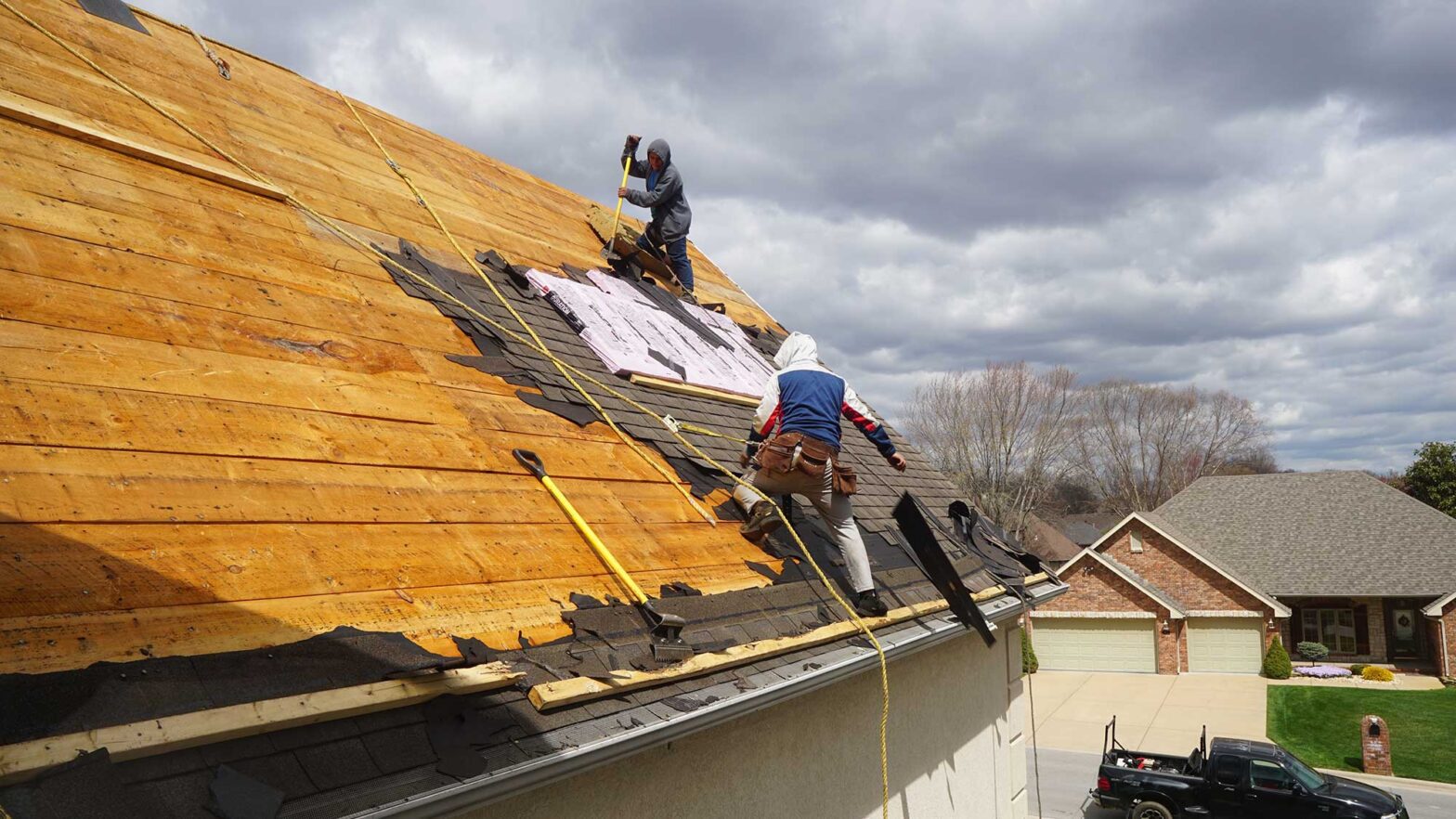
- Tear-off and disposal: $1,200 to $1,800
- Decking replacement at $65 to $95 per sheet (5 to 10 sheets typical): $400 to $950
- Ice and water shield in valleys and around penetrations: $600 to $1,000
- Synthetic underlayment, full coverage: $750 to $1,100
- Architectural shingles installed (25 squares): $9,500 to $13,500
- Drip edge, ridge vent, pipe boots, step flashing, ridge cap: $1,800 to $3,000
- Permit, dumpster, magnetic sweep, final cleanup: $500 to $800
RCV total: $14,750 to $22,150. Your out-of-pocket is your wind and hail deductible only.
05 // Class 4 impact-resistant upgrade
A Class 4 impact-resistant architectural shingle (GAF Timberline AS II, CertainTeed Northgate Climateflex, Owens Corning Duration Storm) adds $800 to $1,800 to a full replacement scope versus standard Class 3. UL 2218 Class 4 means certified to withstand a 2 inch steel ball dropped from 20 feet without splitting.
Most Texas insurers offer a 10 to 30 percent annual discount on the wind and hail portion of your premium after Class 4 installation. On a $4,800 annual premium with a $1,200 wind and hail allocation, that is $120 to $360 per year, which recovers the upgrade cost in 4 to 8 years. Request the credit in writing from your agent before installation; the carrier needs the manufacturer cert from us to apply it.
06 // The deductible math, in plain numbers
Example: $275,000 dwelling coverage, 1 percent wind and hail deductible, hail claim approved at $18,500 RCV. ACV check at $14,200 (RCV minus $1,500 depreciation minus $2,750 deductible). Roof is installed for the full RCV scope. Recoverable depreciation check at $1,500 released after completion documentation. Your total out-of-pocket: $2,750 (the deductible).
Same home, 2 percent deductible: $5,500 out-of-pocket. Same home, named-storm deductible at 5 percent applied because the cell was named: $13,750 out-of-pocket. Read your declarations page before storm season; one in three Houston homeowners we meet does not know which deductible applies to which storm type.
07 // Supplements: what the first scope usually misses
First-look adjuster scopes are written from the ground and from drone photos. They consistently miss: decking replacement (until tear-off exposes it), ice and water shield in code-mandated zones, step and counter flashing at chimneys, ridge ventilation upgrades required by current code, and detached debris (gutters, screens, AC fins) that are covered under the same claim. We supplement every short scope using Xactimate, the same software the adjuster uses. Average Houston supplement adds $1,800 to $4,500 to the original approval. The carrier owes the full scope by policy.
08 // Cost red flags to walk away from
Any contractor who offers to "waive your deductible," "eat your deductible," or "rebate" it at the end is committing a Class B misdemeanor under Texas Insurance Code §707.002. Walk away. Any contractor who demands more than a modest material deposit before work starts (typically the deductible at materials delivery or first day on site) is running an advance-fee scam. Any contractor who refuses to put the scope and price in writing before you sign is hiding something. Get two free inspections from local contractors with verifiable Houston addresses, read both estimates side by side, and choose based on documentation quality, not the lowest number.