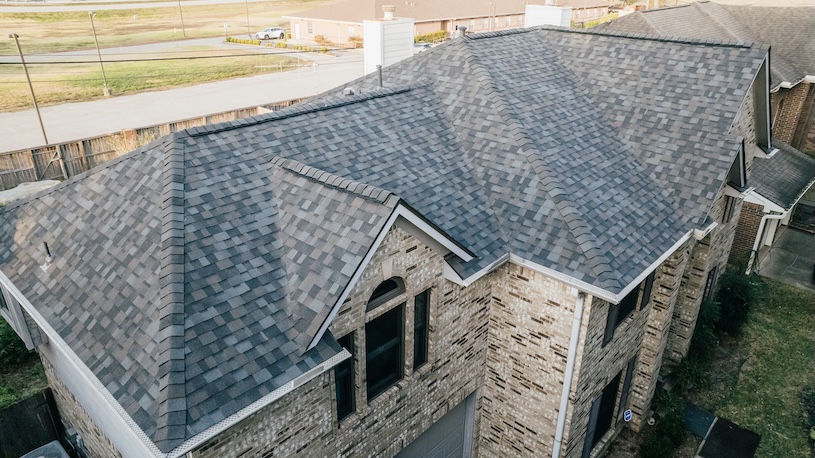
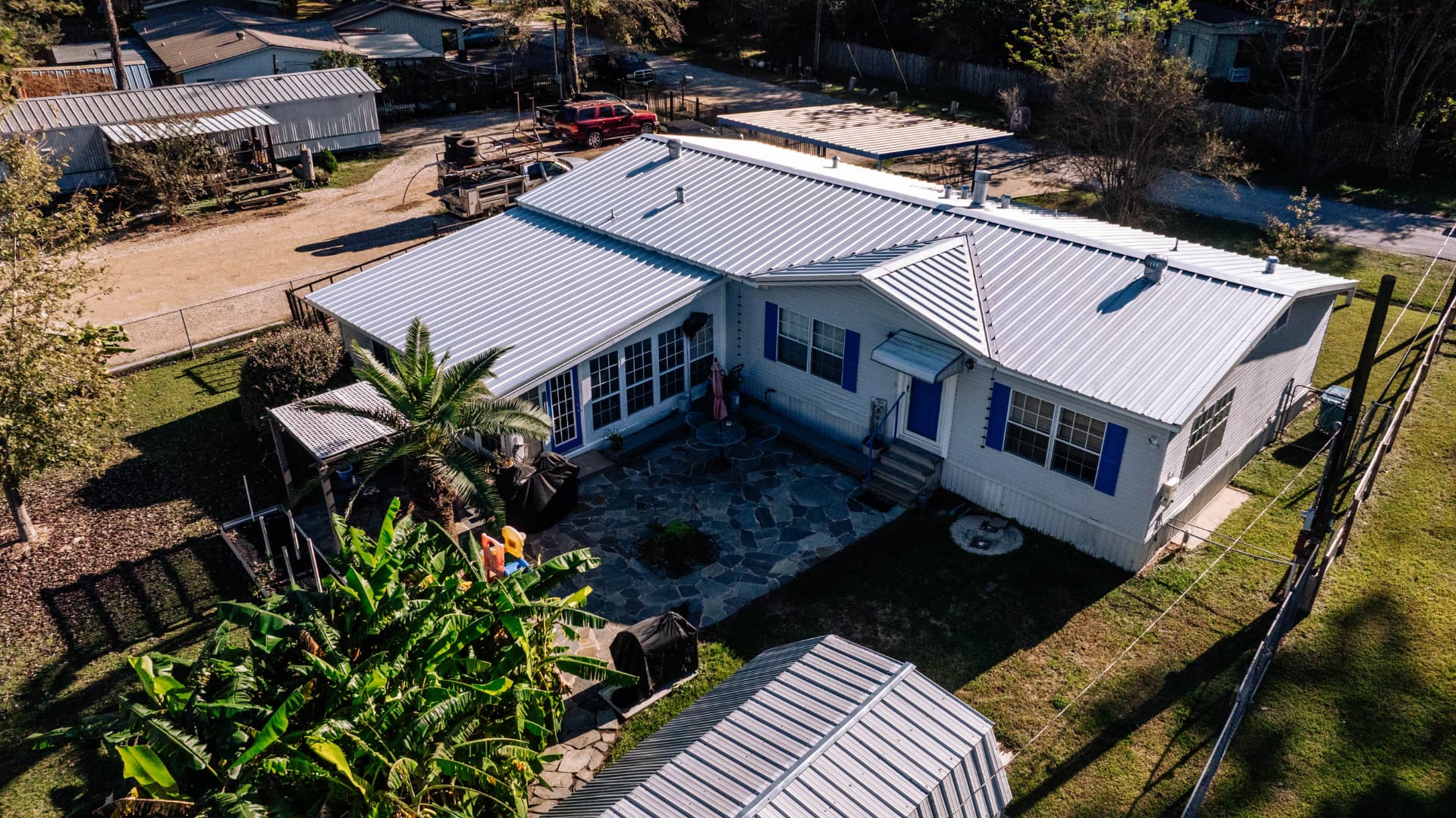
Every week a Houston homeowner asks us the same question: is metal worth the premium? The honest answer is "it depends on how long you plan to own the house." Asphalt wins on year-one cost. Metal wins on year-twenty-five cost. The real decision is whether you can stomach the upfront delta to capture the back-end value, and whether the structure underneath is even ready for what a metal panel demands.
- What costs more upfront?
- Standing seam metal runs roughly 2.2 to 2.8 times the installed cost of an architectural asphalt shingle in Houston. On a 2,500 sq ft roof that's about $14k vs $34k installed in 2026 dollars.
- Which lasts longer?
- A quality 24-gauge standing seam with Galvalume substrate lasts 50+ years. A premium architectural asphalt shingle in a Houston attic lasts 18 to 22 years if ventilation is right.
- Which performs better in a hurricane?
- Both can be installed to UL 580 Class 90 wind ratings. Metal generally outperforms in sustained wind; asphalt outperforms in horizontal hail under 1.5 inches.
Free inspection for your metal vs asphalt for houston homes project
Tell us what you are dealing with and we will schedule a no obligation inspection. Prefer to talk? Call (713) 480-8877.
01 // Year-one installed cost
For a 2,500 square foot Houston ranch with one chimney, four pipe boots, and standard 4/12 pitch in 2026, expect roughly $11,500 to $15,500 for premium architectural asphalt with synthetic underlayment, ice and water shield at penetrations, and a 50-year transferable warranty. The same roof in 24-gauge standing seam Galvalume with a Kynar 500 finish runs $30,000 to $38,000 installed.
The math gets uncomfortable fast. You are paying $20,000 more on day one for a roof that nobody will see from the curb in a one-story neighborhood with mature oaks. The case for metal lives entirely in the years that follow.
02 // Realistic lifespan in the Gulf Coast climate
Manufacturer warranties are not service life. A 30-year shingle in Vermont is a 22-year shingle in Houston, and the south-facing slopes age 30 percent faster than the north. We have torn off 12-year-old shingle roofs that were cooked through and 24-year-old shingle roofs that still had granule cover, and the only difference was attic ventilation. Metal does not care. A properly installed standing seam will outlast your mortgage and probably your ownership of the house.
03 // Energy performance and attic temperatures
An unpainted asphalt shingle absorbs 90 percent of incident solar radiation and re-radiates the heat into the attic below. A Kynar-finish metal panel reflects 30 to 70 percent depending on color (cool roof certified colors hit the higher end). On instrumented Houston attics we measure 18 to 25 degree F differences between asphalt and reflective metal at 3 PM in July. Over a 25-year ownership that adds up to real cooling savings, typically $90 to $180 per year on a 2,500 sq ft home.
04 // Wind and hail performance
Both systems can hit Class 4 impact ratings. Asphalt does it with rubber-modified SBS impregnation; metal does it with thicker gauge. In real Houston storms we see both fail in different ways. Asphalt loses tabs from sustained wind over 95 mph. Metal panels dent from hail over 1.75 inches but rarely leak. For insurance purposes Texas carriers generally treat dented metal as cosmetic and do not pay for replacement, while bruised asphalt is a covered loss. Read your policy before you decide.
05 // Structural and sound considerations
Standing seam weighs 1.0 to 1.4 pounds per square foot. Asphalt weighs 2.5 to 3.5. If you are switching from a 30-year tile roof to either, your structure is fine. If you are putting standing seam over a marginal 1980s framing system, even less load is welcome. Sound is the surprise: a properly underlayed metal roof is quieter than asphalt in a hailstorm because the closed-cell underlayment kills the resonance. Bare-deck metal in a barn rattles. Metal on a finished home does not.
06 // Resale impact in the Houston market
Realtor data on the Houston MLS shows metal-roofed homes selling for an average premium of 6 percent in custom and luxury segments and roughly break-even in production-built tract neighborhoods. The premium correlates strongly with neighborhood comps; in a subdivision where 90 percent of homes have shingles, a metal roof is a curiosity, not a value-add. In ranchette and acreage properties, it is increasingly the expectation.
07 // The honest verdict
Buy metal if you plan to own the home for 15+ years, you can absorb a $20k+ premium without financing it at 9 percent, and your insurance carrier does not exclude cosmetic damage. Buy premium architectural asphalt if you are inside a 10-year window, the home is in a tract neighborhood, or you would rather invest the delta in attic insulation, impact windows, or a generator. Neither choice is wrong; the wrong choice is letting a salesman tell you metal is "always" worth it.