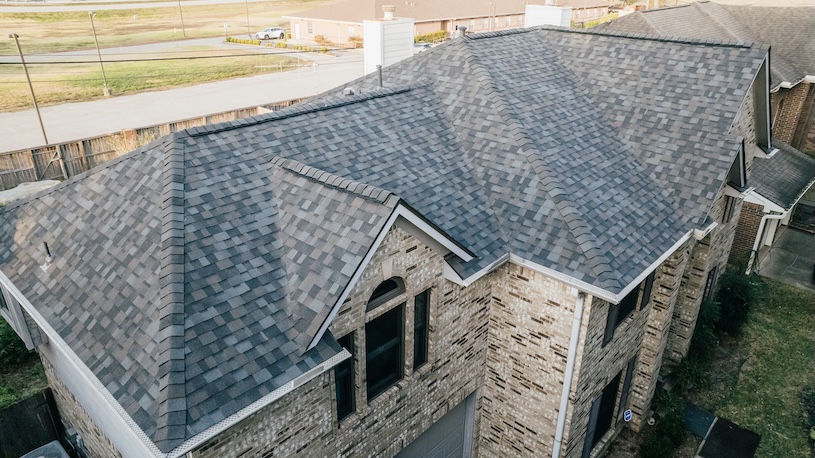
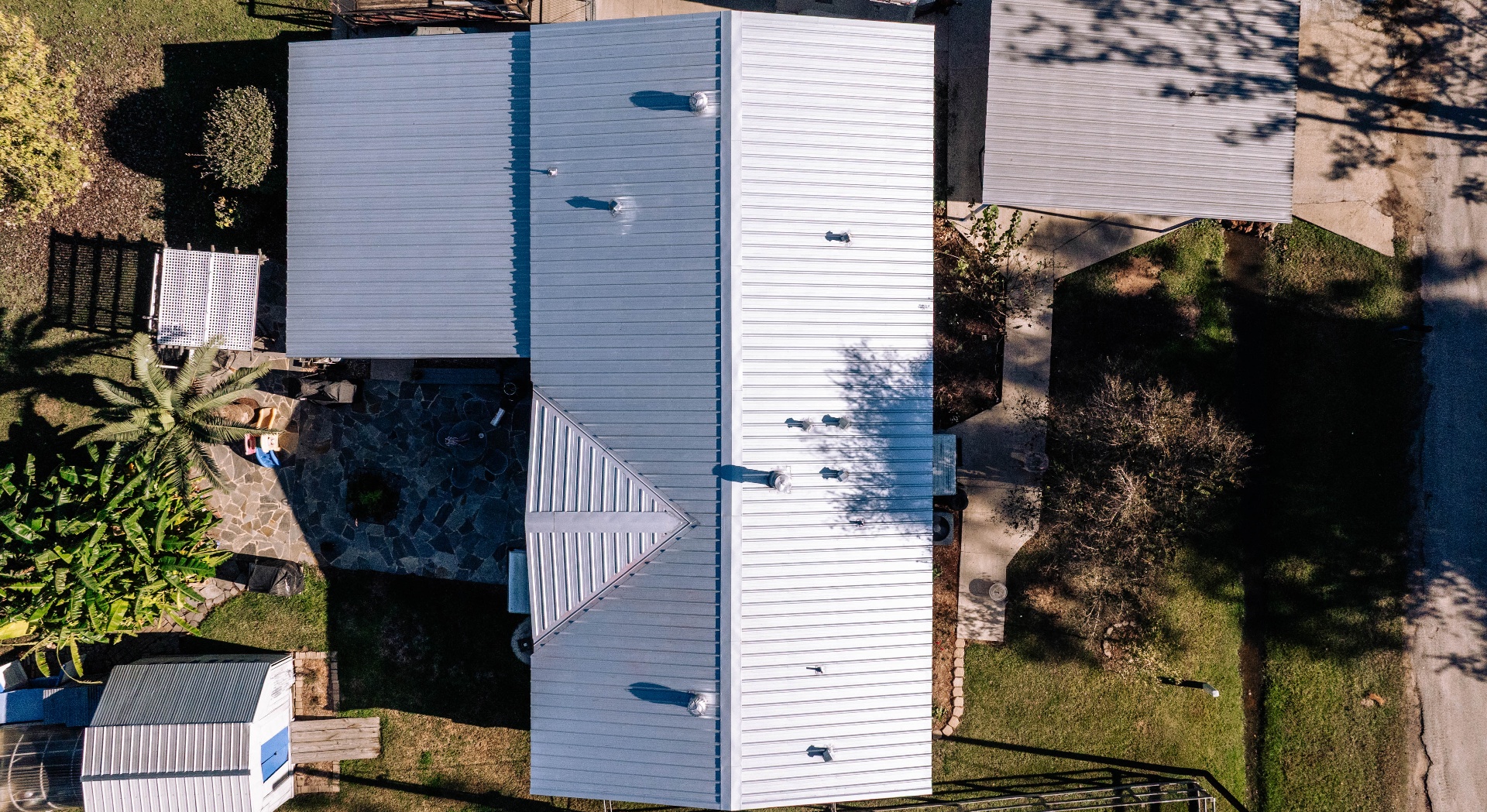
Most online "roof cost calculators" ask for your email, square footage, and your zip code, then spit out a number that is rarely within 30 percent of an honest local quote. They cannot see your roof. They do not know your pitch, your decking condition, or whether you have a one-layer or two-layer tear-off underneath. This worksheet uses the same six inputs our estimators run on every job and gets you to a number that should be within 10 to 15 percent of a real Houston quote.
- How accurate is this?
- Within 10 to 15 percent of an honest local quote if you measure your house carefully. We give you the formula, not a black-box number.
- What do I need to start?
- Tape measure or Google Maps satellite view, your roof pitch (or the table below), and 5 minutes.
- Do I have to give my email?
- No. Nothing on this page is gated. If you want a real quote afterward, you can request one from our contact page.
- What if my roof is complex?
- The pitch and complexity multipliers in Step 4 handle that. Hip roofs with multiple valleys add 15 to 25 percent.
Free inspection for your roof replacement cost calculator for houston homes project
Tell us what you are dealing with and we will schedule a no obligation inspection. Prefer to talk? Call (713) 480-8877.
01 // Step 1: get your roof square footage
The fastest free method: Google Maps satellite view. Search your address, zoom in until you can see the full roof, switch to satellite, and use the distance tool (right-click, "Measure distance") to measure each plane of the roof in feet. Multiply length times width for each rectangular plane, add them up. Add 5 to 10 percent for cuts, waste, and the fact that satellite measurements are slightly off.
The contractor method: your house footprint from the tax records times your pitch multiplier (see Step 4). A 2,000 sq ft single-story footprint with a 6/12 pitch has roughly 2,260 sq ft of roof. A 2,000 sq ft footprint with an 8/12 pitch has roughly 2,400 sq ft of roof.
Roofers price by the "square" (100 sq ft). A 2,400 sq ft roof is 24 squares.
02 // Step 2: identify your roof pitch
Pitch is rise over run, measured in inches per 12 inches. Walk to a corner of your house, sight up at the slope from across the street, and compare to these silhouettes:
- 4/12 (low-slope, walkable): looks nearly flat from the street, common on 1960s and 1970s ranch homes.
- 6/12 (standard Houston): moderate slope, the most common pitch in suburban Houston.
- 8/12 (steep walkable): noticeably steep, common on two-story homes built post-2000.
- 10/12+ (not walkable): very steep, common on Heights Victorians and Memorial Tudor-style homes. Requires harness setups and adds significant labor cost.
03 // Step 3: pick your material
Use the 2026 Houston per-square-foot installed pricing:
- Architectural asphalt (Class 3): $4.75 to $8.50 per sq ft
- Impact-resistant asphalt (Class 4): $9 to $14 per sq ft
- Standing seam metal: $12 to $22 per sq ft
- Clay or concrete tile: $18 to $30 per sq ft
Use the low end of the range for a simple single-story 4/12 with clean decking. Use the high end for a steep two-story with multiple valleys or decking replacement expected.
04 // Step 4: apply complexity multipliers
Take your base estimate (sq ft times per-sq-ft price) and apply these multipliers in sequence:
- Pitch multiplier: 4/12 = 1.00, 6/12 = 1.05, 8/12 = 1.15, 10/12 = 1.30, 12/12+ = 1.45
- Cut-up multiplier: simple gable = 1.00, basic hip = 1.10, complex hip with dormers = 1.20, multiple valleys and dormers = 1.30
- Two-story multiplier: single-story = 1.00, two-story = 1.10, three-story = 1.20
- Tear-off multiplier: single layer = 1.00, double layer = 1.15
Multiply all four against your base estimate. Example: 2,400 sq ft architectural ($6 per sq ft) on a two-story 8/12 hip with one layer to tear off = 2,400 x $6 x 1.15 x 1.10 x 1.10 x 1.00 = $20,909.
05 // Step 5: budget for decking and ventilation
Add a contingency for decking replacement: $75 to $110 per replaced sheet, expect 0 to 15 sheets on a typical Houston home. Budget $500 to $1,500 for this. Add $400 to $1,200 for ventilation upgrades if your current roof has gable vents or no ridge vent. These two items together typically add 5 to 10 percent to the final bill, and skipping them is the single biggest reason Houston roofs fail early.
06 // Step 6: sanity-check against quotes
Your calculated estimate should land within 10 to 15 percent of an honest local quote. If quotes come in 25+ percent lower, something is missing (verify underlayment grade, drip edge gauge, warranty length, permit, dump fees). If quotes come in 25+ percent higher, you may be talking to a storm-chaser or a heavily-marketed franchise. Get at least one quote from an established local contractor with a physical office. See our 2026 Houston roof pricing guide for the full breakdown of what should be in every quote.