A roof leak rarely picks a convenient time. It shows up at 11pm during a Houston squall line, or as a slow tan stain that grows half an inch every week through hurricane season. The fastest, cheapest fix is almost always the early one. We diagnose and stop most Houston roof leaks the same day, then come back with a permanent repair within a few business days. This page explains how leaks actually travel through a roof, what we charge, and how to tell whether the right answer is a $400 repair or a full replacement.
- Same-day service?
- Yes for active leaks during business hours. Call (713) 480-8877.
- Typical cost?
- $300 to $900 for single-source leaks. Fixed price after inspection.
- Warranty?
- All workmanship warranted in writing. Manufacturer warranty preserved.
- Service area?
- All of Greater Houston including Heights, Memorial, Katy, Sugar Land, The Woodlands.
Free inspection for your roof leak repair houston project
Tell us what you are dealing with and we will schedule a no obligation inspection. Prefer to talk? Call (713) 480-8877.
The most common Houston roof leak sources
About 80 percent of the leaks we repair in the Houston metro trace back to one of seven sources:
- Failed pipe boots. The neoprene gasket around plumbing vents fails after 8 to 12 years in Texas sun. The single most common Houston roof leak.
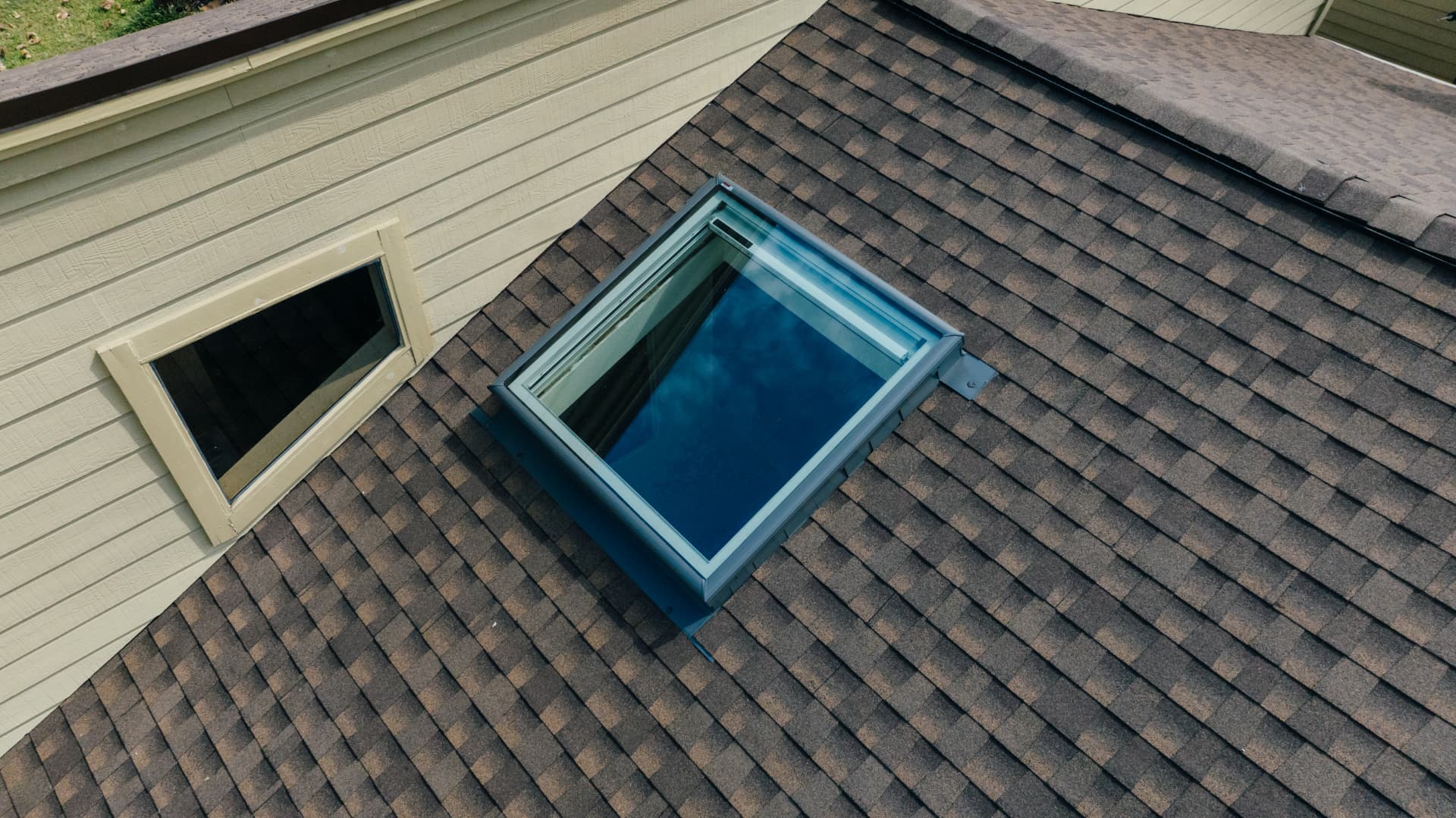
- Damaged or missing flashing at chimneys, walls, skylights, and dormers. Often the result of a prior amateur repair sealed with caulk instead of step flashing.
- Lifted or missing shingles from wind events.
- Exposed or popped nails from thermal cycling, each a small but persistent leak path.
- Clogged or undersized valleys that overflow during heavy rain.
- Failed roof-to-wall transitions on additions where two rooflines meet, especially when stucco siding is involved.
- Skylight perimeter seal failure, common on units installed before 2005 with original flashing kits.
How we trace a leak back to its source
Water in the ceiling rarely enters the roof directly above the stain. It enters at a high point and runs along the underside of the deck, down a rafter, or across a ceiling joist before finding its exit. Diagnosis is part visual inspection and part deduction.
We start in the attic with a thermal camera and moisture meter, mapping the wet zone. We then move to the roof and inspect every penetration, transition, and flashing within a 15-foot radius uphill of the wet zone. If visual inspection is inconclusive, we run a controlled water test: a helper inside the attic with the meter, a roofer outside running a hose in measured zones until water appears.
The diagnosis is in writing before we quote the repair. You see the source, the leak path, and the recommended scope.
When a leak means repair, and when it means replacement
Three questions decide:
- How old is the roof? A leak on a 6-year-old roof is almost always a single-source repair. A leak on a 20-year-old asphalt roof is usually the first of many.
- Is the source isolated or systemic? One bad pipe boot is a repair. Three failed pipe boots and brittle shingles across the field is end-of-life.
- What does the deck look like? Soft or rotted decking under the leak means more water has been getting in for longer than the homeowner realized. Larger repairs and sometimes replacement are warranted.
For a deeper checklist, see 7 signs it is time to replace your roof.
What a real repair looks like
For a failed pipe boot we remove the surrounding shingles, install a new lead-flange or rubberized boot rated for 50-year service life, replace the underlayment cutout, and re-shingle with a color match from your existing manufacturer. Total time on site about two hours.
For a flashing rebuild we strip the existing counter-flashing and step flashing, install new pre-bent step flashing under each shingle course, install new counter-flashing tucked into a fresh kerf cut in the masonry, seal with butyl and polyurethane, and re-shingle. Time on site about a half day.
For a lifted shingle field we lift, re-set with new fasteners, hand-seal with roofing cement under the tab, and replace any damaged shingles. Time on site varies with scope.
Every repair is photographed before, during, and after. You receive the photo set with the invoice.
What you can and cannot DIY
You can safely tarp a leak from the ground using a hose-anchored tarp tossed over the ridge during dry weather. You can place buckets and plastic indoors. You can move furniture and electronics out of the wet zone.
You should not climb a wet roof, you should not apply roofing tar or aerosol leak sealants (they make the eventual real repair more expensive), and you should not assume the leak is small because the stain is small. Read the CDC's storm safety guidance before any DIY response.
After the repair: warranty and follow-up
Every Invictus repair carries a written workmanship warranty. The warranty is on the invoice, not buried in a separate document, and it is honored as long as we are in business. We follow up with a check-in call after the next major rain to confirm the repair is dry. If there is any question we are back on the roof at no charge.
Same-day diagnosis
Drone, attic, thermal camera, and water test where needed.
Fixed-price quote
Written scope and price before we start. No hourly surprises.
Stocked trucks
Common boots, flashing, and shingles on board for first-visit repair.
Written workmanship warranty
On the invoice. Honored without games.
Manufacturer warranty preserved
Repair documented with materials and lot numbers.
Follow-up included
Post-storm check-in call to confirm the repair is dry.