Houston attics hit 145F by mid-July. That heat does not stay in the attic, it conducts down through the asphalt mat of the shingle and cooks the roof from the bottom side. Combine that with 70 percent relative humidity for 5 months of the year and you get the two failure modes Gulf Coast roofs are famous for: granule loss that ages a 25-year shingle to a 14-year shingle, and decking rot that nobody sees until the next replacement tears off the OSB.
Ventilation is the single biggest variable in how long your Houston roof lasts. A properly ventilated attic with balanced intake and exhaust runs 15 to 25 degrees cooler in summer and keeps moisture moving out instead of condensing on the underside of the decking. We get asked about ventilation more than any other detail on inspections. This post covers what actually works in Houston specifically, the four systems we install, and the math on why most builder-grade roofs never reach their warranty age.
- How much ventilation does my Houston attic need?
- Code minimum is 1 sq ft of net free vent area for every 150 sq ft of attic floor (the 1:150 rule), split roughly 50/50 between intake (low) and exhaust (high). Houston humidity rewards going to the 1:300 rule with a vapor retarder, but most retrofits use 1:150 to be safe.
- Ridge vent or power vent?
- Continuous ridge vent paired with continuous soffit intake is the gold standard for Houston. Power vents work but draw conditioned air from the house when poorly balanced, which raises your AC bill.
- Can Invictus inspect my ventilation for free?
- Yes. Every free roof inspection includes an attic walk to verify intake clearance, exhaust net free area, baffle condition, and signs of moisture damage on the decking. Call (713) 480-8877 or book online.
Free inspection for your attic ventilation in humid houston summers project
Tell us what you are dealing with and we will schedule a no obligation inspection. Prefer to talk? Call (713) 480-8877.
01 // How attic ventilation actually works in humid climates
Hot air rises. Cool air falls. That is the entire engine of passive attic ventilation. Air enters the attic at the soffit (low and at the eave), absorbs heat and moisture as it moves up the underside of the roof deck, and exits at the ridge (high and at the peak). The system needs both ends open in roughly equal area. Block the intake and the exhaust does nothing. Block the exhaust and the intake does nothing.
In a dry climate, the only job is heat removal. In Houston, the system has a second job: moisture management. Every cubic foot of attic air in July holds 4 to 6 times the water vapor of the same air in Denver. That moisture has to keep moving or it condenses on the underside of the decking overnight when the attic cools, soaks the OSB, and rots it from the back side. By the time you can see the damage from inside the attic, the decking is already at the end of its life.
02 // The 1:150 rule (and when to use 1:300)
International Residential Code requires 1 sq ft of net free vent area (NFVA) for every 150 sq ft of attic floor. A 2,000 sq ft Houston home needs 13.3 sq ft of NFVA total, split 50/50 between intake and exhaust. That is 6.65 sq ft each side, or roughly 957 sq inches.
The 1:300 rule cuts that in half (4.4 sq ft of NFVA on a 2,000 sq ft attic) but only applies when you have a Class I or II vapor retarder on the warm side of the ceiling. Most Houston homes do not have a code-compliant vapor retarder, so we design to the 1:150 rule by default. The penalty for over-venting is essentially zero. The penalty for under-venting is a roof that fails 8 years early.
Net free vent area is not the same as the physical hole size. A 16 inch round gable vent is roughly 200 sq in physical area, but the louver and screen cut that to about 65 sq in NFVA. Always use the manufacturer's published NFVA number, not the hole measurement.
03 // Why most Houston intake is choked off
Drive any Houston neighborhood built in the last 30 years and look up at the soffits. You will see vented panels or continuous perforated strips designed to deliver intake air. Climb into the attic and you will find that 60 to 80 percent of those panels are doing nothing.
The three killers of intake ventilation in Houston: blown-in insulation packed against the eave with no baffle, paint sealing the perforations on the underside, and wasp/mud dauber nests built into the soffit cavity. We have inspected 1990s and 2000s production homes where the entire intake side of the system is sealed and the homeowner has no idea why their attic is 165F in July and their shingles are losing granules by year 9.
The fix is cheap. Install rafter baffles at every bay to hold insulation back from the soffit, blow out the perforated panels with compressed air, and replace any soffit panels that are damaged or covered in 6 layers of paint. A retrofit on a typical Houston home runs $400 to $900.
04 // The four exhaust systems we install in Houston
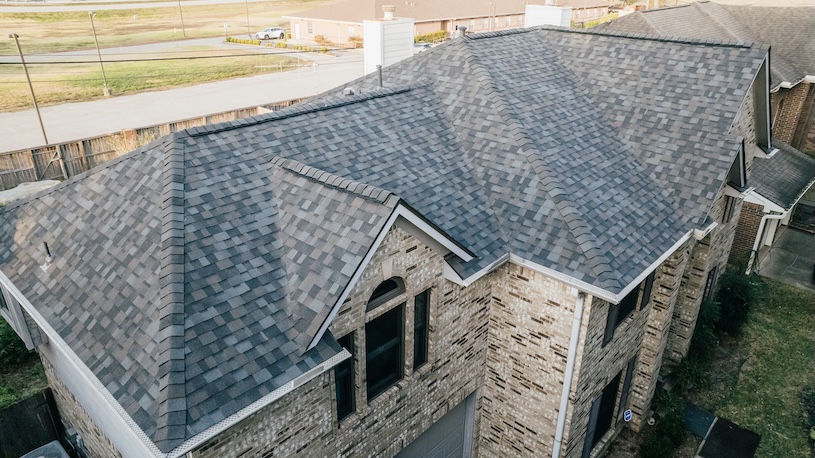
Continuous ridge vent. The default and best option for any Houston roof with at least 15 ft of unbroken ridge. Cuts a 2 inch slot the length of the ridge and caps it with a vented baffle plus matching ridge shingle. Works passively, has no moving parts, and pairs with continuous soffit intake for a perfectly balanced system. 18 to 22 sq in NFVA per linear foot, or roughly 360 sq in NFVA on a 20 ft ridge.
Box vents (turtle vents). The retrofit choice for homes with limited ridge length or complex hip rooflines. Each box vent delivers 50 to 65 sq in NFVA, so a 2,000 sq ft house needs 8 to 12 of them spaced evenly across the high half of the roof. Less visually clean than ridge vent but functionally equivalent when properly sized.
Power vents (PAV). Thermostat or humidistat-triggered electric fans. Move air aggressively (1,000 to 1,500 CFM each) but draw conditioned air from the house if the intake side is undersized. We install them on homes where ridge vent is not viable and the homeowner wants active control. Pair with a humidistat in Houston, not just a thermostat, so the fan runs during high-humidity nights.
Solar-powered attic fans. A subset of power vents with the appeal of zero operating cost. The good ones (40 watt and up with a built-in thermal switch) work fine. The cheap ones (15 to 25 watt big-box brands) do not move enough air to matter. We install them when the homeowner specifically asks, but ridge vent is almost always the better answer.
05 // Do not mix exhaust types on the same attic
The single most common mistake we see on Houston roofs: ridge vent plus box vents plus a gable vent plus a power vent, all on the same attic. Looks like belt and suspenders. Actually short-circuits the whole system.
When you have two different exhaust types at different heights, the higher one pulls intake air from the lower one instead of from the soffits. The soffit intake stops doing its job, the lower exhaust becomes an intake, and the half of the attic between them barely moves air at all. Pick one exhaust type per attic and stick with it. If you have a gable end with an existing gable vent and you add ridge vent, the gable vent gets blocked off with rigid foam from the inside.
Power vents are even more sensitive. A power vent running on the same attic as a ridge vent will pull air down through the ridge vent, defeating both. Either choose passive ridge or active power, not both.
06 // Six signs your Houston ventilation is failing
- Black or dark staining on the underside of the decking. Mold from chronic moisture. By the time it is visible, the decking has been wet for at least 18 months.
- Rusted nail heads in the attic. The nails are wicking moisture from the underside. Same root cause as the staining.
- Curling or cupping shingles, especially on the south slope. The shingles are being baked from below because attic temps are too high.
- Premature granule loss in the gutter (washout) at year 7 to 10. The asphalt mat is degrading from heat.
- Frost or condensation on the underside of the decking in winter. Moist attic air condensing on cold sheathing. Houston gets this 5 to 10 nights per winter.
- AC bills that climb every July despite no change in setpoint. The ceiling is radiating heat from a 145F attic into the conditioned space.
07 // What ridge vent retrofit actually costs in Houston
On a re-roof, adding ridge vent costs $400 to $900 in additional labor and material on a typical 24 to 32 square Houston home. That includes cutting the ridge slot, installing the vented baffle, and replacing the standard ridge cap with matching vented ridge shingle. As a standalone retrofit on an existing roof (without doing a full replacement), the same scope runs $1,200 to $2,200 because the crew has to pull and reset the existing ridge cap. Either way, the payback is fast: a properly ventilated roof in Houston extends shingle life by 4 to 7 years on a 25-year architectural product, which is $4,000 to $8,000 of deferred replacement.
Code minimum
1 sq ft NFVA per 150 sq ft of attic, split 50/50 intake vs exhaust.
Houston default
Continuous ridge vent + continuous soffit intake. Passive, balanced, no moving parts.
Do not mix
Pick one exhaust type per attic. Ridge + power + gable on the same attic short-circuits the system.
Intake matters most
60 to 80 percent of Houston intake panels are choked by insulation, paint, or wasp nests. Cheapest fix on a roof.