Most Houston homeowners do not realize their gutters are undersized until they stand on the porch during a 4-inch-per-hour July downpour and watch water cascade over the front edge like a sheet of glass. The system is not clogged. The hangers are not loose. The pitch is fine. The gutters are simply too small for the roof area they drain. This post covers how to size gutters using actual drainage math, when 5 inch K-style works, when 6 inch is mandatory, and what downspout size has to pair with each. If you would rather skip the math and get a sized quote, our free gutter estimator takes about 60 seconds.
- Short answer?
- 5 inch K-style for single-story simple gables. 6 inch K-style for two-story, steep pitch, valley dumps, or roof drainage zones above 1,800 sq ft.
- Downspout pairing?
- 5 inch gutters get 2x3 downspouts. 6 inch gutters get 3x4 downspouts (44 percent more capacity).
- Cost difference?
- 6 inch K-style runs $2 to $4 more per linear foot installed. On a 180 ft home, $360 to $720 more for the right size.
Schedule Your Free Roof Inspection
Tell us what you are dealing with and we will schedule a no obligation inspection. Prefer to talk? Call (713) 667-8165.
Houston rainfall: the number gutters get sized for
Houston averages 50 inches of rain per year, but the number that matters for gutter sizing is peak intensity, not annual total. Harris County design rainfall for a 10-year storm is 6 to 7 inches per hour. The 100-year storm hits 9 to 10 inches per hour for short bursts. Gutters that handle a steady April drizzle fail catastrophically during a July squall because the flow rate is 10x higher.
Standard sizing tables built for the Midwest assume 5 inches per hour peak rainfall. Using those tables in Houston is how you end up with overflowing gutters on a brand-new install.
Drainage zones: not the same as total roof area
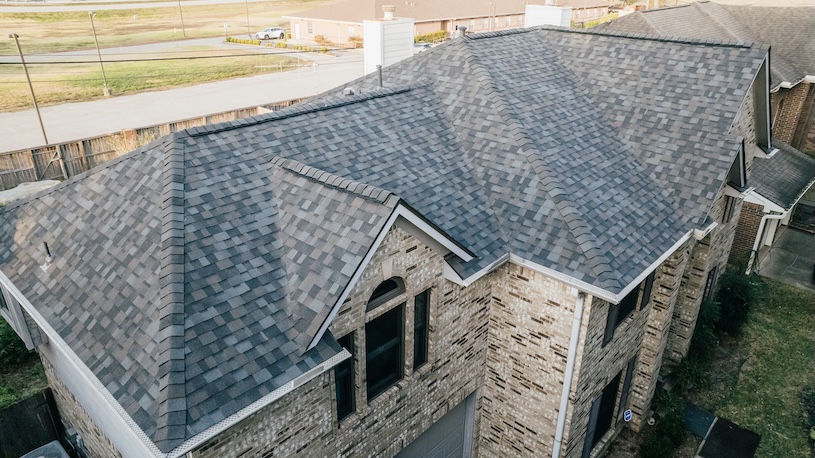
A gutter does not drain the whole roof. It drains the slope (or slopes) that pitch toward it. A simple gable roof has two drainage zones (front and back). A hip roof has four. A complex roof with valleys, dormers, and porches can have eight or more, and the gutter under a valley sees concentrated flow from two slopes converging.
Sizing is done zone by zone. Measure each slope, multiply length by width to get sq ft, then add 20 percent if the pitch is steeper than 6/12 (steeper roofs shed faster, concentrating flow). A drainage zone over 1,800 sq ft requires 6 inch gutters. A valley dump zone over 1,200 sq ft requires 6 inch.
5 inch vs 6 inch: actual capacity numbers
A 5 inch K-style aluminum gutter handles roughly 5,520 sq inches of cross-section flow per minute at standard 1/4 inch per 10 ft pitch. A 6 inch K-style handles 7,960 sq inches per minute. That is 44 percent more capacity for one extra inch of width.
Translated to roof area at Houston peak rainfall: 5 inch gutters handle drainage zones up to about 1,500 sq ft before overflow. 6 inch gutters handle up to about 2,200 sq ft. Two-story homes with 2,400 sq ft footprints almost always have at least one drainage zone over 1,500 sq ft.
Downspouts are usually the actual bottleneck
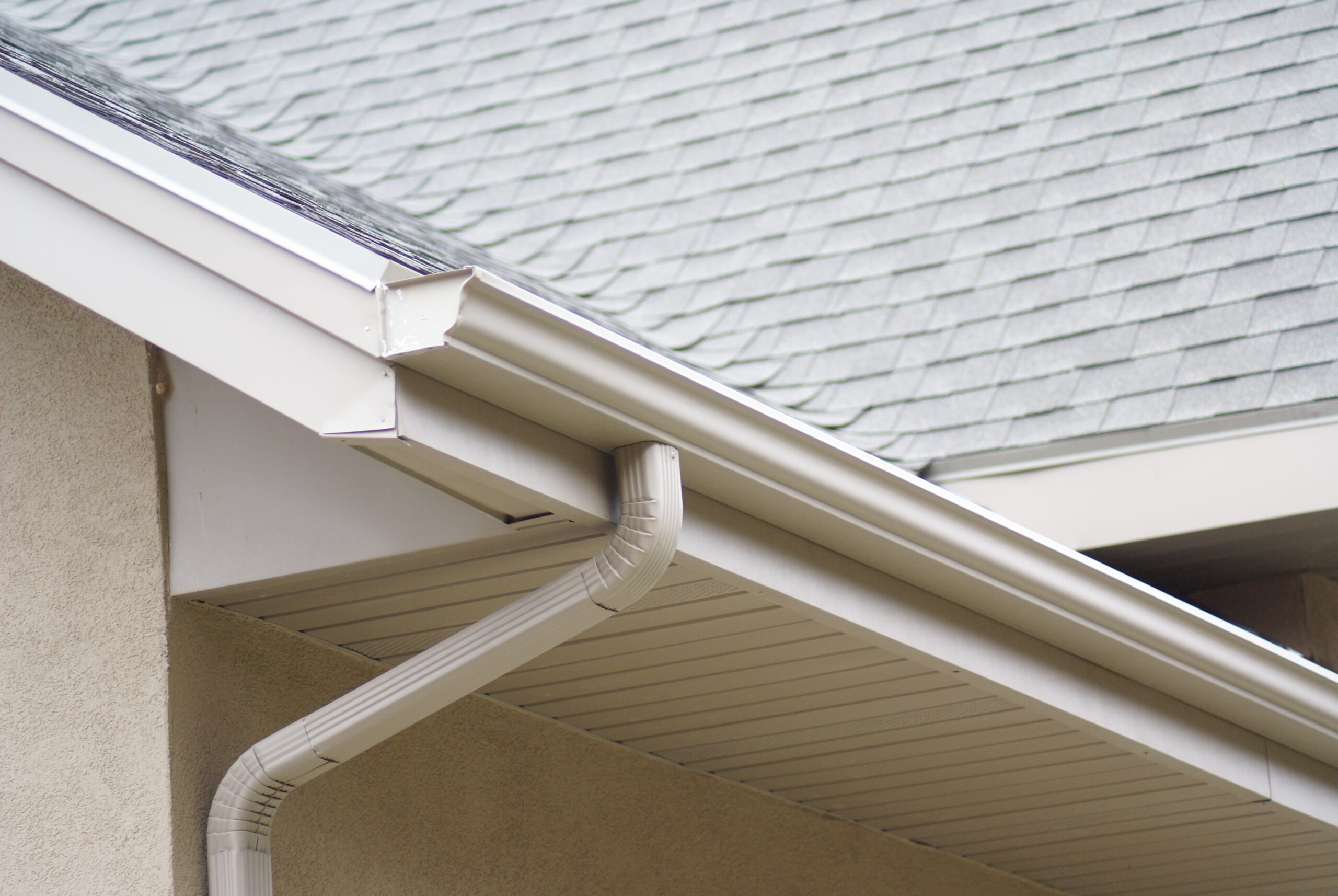
Most overflow problems we diagnose in Houston are not the gutter, they are the downspout. A 2 inch by 3 inch downspout moves 600 gallons per hour. A 3 inch by 4 inch downspout moves 1,200 gallons per hour. Production builders pair undersized 2x3 downspouts with 5 inch gutters on two-story homes because they are cheaper, even when the gutter run can technically handle the flow.
Rule of thumb: every 800 sq ft of drainage zone needs one 2x3 downspout, or every 1,400 sq ft needs one 3x4 downspout. A 6 inch gutter with a single 2x3 downspout at the end is still going to overflow.
When 5 inch K-style is the right call
Single-story home, simple gable or hip roof with no valley dumps, drainage zones under 1,500 sq ft, pitch 6/12 or less, and at least one 2x3 downspout per 800 sq ft of zone. Most 1,500 to 2,000 sq ft single-story Houston homes built before 1990 fit this profile. 5 inch is cheaper, looks lighter on a smaller home, and handles the flow without issue.
When 6 inch K-style is mandatory
Any of these conditions on their own require 6 inch with 3x4 downspouts: two-story home, pitch 8/12 or steeper, valley dumping into the gutter, drainage zone over 1,800 sq ft, large patio cover or porch roof draining into the main house gutter, or chronic overflow on the existing 5 inch system. Two or more conditions makes 6 inch non-negotiable.
Half-round and copper: separate sizing rules
Half-round gutters have less cross-section than K-style at the same nominal width. A 6 inch half-round handles roughly the same flow as a 5 inch K-style. For copper or aluminum half-round on a Houston home, default to 7 inch unless the drainage zone is very small. The aesthetic premium is real, but undersized half-round on a two-story brick home will overflow at every storm.
Frequently Asked Questions
- My builder installed 5 inch gutters on a two-story house. Can I just add more downspouts?
- Helps but rarely solves it. The gutter trough itself is the limiting factor on steep pitches and valley dumps. The fix is to replace with 6 inch oversized gutters and 3x4 downspouts. Adding a downspout to 5 inch gutters is a band-aid that delays the real solution.
- Do 6 inch gutters look out of proportion on a smaller home?
- On a 1,200 sq ft single-story bungalow, yes. On any two-story or any home with a steep pitch and complex roofline, 6 inch looks proportionate. The 1 inch difference is not noticeable from the curb.
- What about box gutters or commercial sizes?
- Box gutters (8 inch or larger custom-fabricated) are used on commercial buildings and on residential properties with truly extreme drainage zones (over 3,500 sq ft per zone). Residential Houston homes almost never need them. If a contractor recommends box gutters on a normal house, get a second opinion.